commentary
The Summe of Christian Religion
1587 · 207 entries
API: GET /api/v1/documents/ursinus1587
- By
- Zacharias Ursinus
- Dates
- first published 1587
- Tradition
- reformed
- Also called
- The Summe of Christian Religion … Deliuered by Zacharias Vrsinus in his Lectures vpon the Catechism; Doctrinae Christianae Compendium; Ursinus’s Lectures on the Heidelberg Catechism
- Follows
- The Summe of Christian Religion: Deliuered by Zacharias Vrsinus in his Lectures vpon the Catechism autorised by the noble Prince Frederick, throughout his dominions: Wherein are debated and resolued the Questions of whatsoeuer points of moment, which haue beene or are controuersed in Diuinitie. Translated into English by Henrie Parrie, out of the last & best Latin Editions, together with some supplie of wants out of his Discourses of Diuinitie, and with correction of sundrie faults & imperfections, which ar as yet remaining in the best corrected Latine, the first edition of Parry’s translation, printed by Joseph Barnes, sold in Paul’s Churchyard at the sign of the Tiger’s Head, 1587 (Huntington Library) (Oxford); STC 24532, ESTC S118924 · the scan (PDF) , from ProQuest
- Transcribed
- From EEBO-TCP A14216Checked against a copy at ProQuest: every page of the catechism (pp. 1–2, 58–59, 204–224 and 811–824), word by word, with every margin reference and where each proof letter stands; every heading; and twenty-five pages drawn at random, word by word; every reference the importer couldn’t read, or read out of the Bible, by Claude, for cco3, 2026-10-30
- License
- Public domain
- Notes
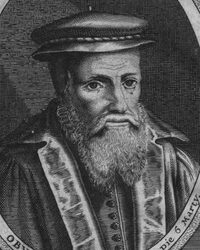
Zacharias Ursinus (1534–1583), the Heidelberg Catechism’s chief author, lectured on it at Heidelberg; his students’ notes of the lectures were printed in Latin from 1584 (Doctrinae Christianae Compendium), and Henry Parry (1561–1616), then of Corpus Christi College, Oxford, later bishop of Worcester, put them into English as The Summe of Christian Religion, “out of the last & best Latin Editions”, in 1587, the first of many English printings (David Pareus’s enlarged edition, in English from 1645, is EEBO-TCP A64611). It prints the catechism in four runs (questions 1–2; 3–11, the misery of man; 12–85, his deliverance; 86–129, his thankfulness), each followed by Ursinus’s lectures on it in common places, which ask their own chief questions (“1 What sinne is”) and answer objections. Each of the 129 questions is an entry, as Parry prints it, its answer cut at the proof letters into segments, the letters’ references the proofs; each common place (78 of them, with the openings of the parts) is an entry whose
textis Markdown, its margin notes footnotes, on the questions it treats, set by its subject; each entry’spartis the book’s part. The dedication to the Earl of Pembroke and Parry’s epistle to the reader areprose/; the title page and the table of common places are left out. Imported from EEBO-TCP A14216 byscripts/import-tcp.mjs(--kind commentary --on heidelberg --lectures --italic-j), keeping its spelling and its marks for what it couldn’t read (•, 〈◊〉, ▪, and 〈 in non-Latin alphabet 〉 for Greek and Hebrew), but where the scan was read.EMENDATIONS.mdgives the conventions, which questions each lecture is on, and every correction: the TCP’s misreadings and gaps, and the printing’s references that can’t be right. The PDF is ProQuest’s scan of EEBO’s film of the Huntington copy, the TCP’s film, with ProQuest’s credit line taken off each image; archive.org’s film catalogued as this printing (bim_early-english-books-1475-1640_the-summe-of-christian-r_ursinus-zacharias_1587) is the edition of 1591.- On
- Heidelberg Catechism (1563)
- Download
- ursinus1587.json · 2.7 MB
Prefaces and appendices
- TO THE CHRISTIAN READERS HENRY PARRIE WISHETH GRACE AND PEACE THROVGH IESV CHRIST OVR LORD
- TO THE RIGHT HONORABLE, HENRIE EARLE OF PENBROOKE, LORD HARBERT OF CARDIFF, MARMION, AND S. QVINTINE, KNIGHT OF THE MOST NOBLE ORDER OF THE Garter, and Lord President of WALES, Grace and peace, with encrease of Honor
Contents
A CATECHISM OF CHRISTIAN RELIGION
- 1What is thy only comfort in life and death?HC Q. 1
- 2How many things are necessary for thee to know that thou, enjoying this comfort, mayest live and die happily?HC Q. 2
- 3There is a three-fold order, or there are three partes of the studie of diuinitieHC Q. 2
- 4OF THE HOLY SCRIPTVREHC Q. 2
- 5OF THE TRVE COMFORT of the GodlieHC Q. 1
THE FIRST PART, OF THE MISERIE OF MAN
- 6Whence knowest thou thy misery?HC Q. 3
- 7What doth the law of God require of us?HC Q. 4
- 8Canst thou keep all these things perfectly?HC Q. 5
- 9Did God then create man so wicked and perverse?HC Q. 6
- 10Whence then proceeds this depravity of human nature?HC Q. 7
- 11Are we then so corrupt that we are wholly incapable of doing any good, and inclined to all wickedness?HC Q. 8
- 12Doth not God then do injustice to man, by requiring from him in his law, that which he cannot perform?HC Q. 9
- 13Will God suffer such disobedience and rebellion to go unpunished?HC Q. 10
- 14Is not God then also merciful?HC Q. 11
- 15OF THE MISERIE OF MANHC Q. 3HC Q. 4HC Q. 5
- 16THE COMMON PLACE OF SINNEHC Q. 5HC Q. 7HC Q. 8HC Q. 10
- 17OF THE CREATION OF MANHC Q. 6
- 18THE QVESTIONS OF MANS CREATION ARE ESPECIALLIE TWOHC Q. 6
- 19OF THE IMAGE OF GOD IN MANHC Q. 6
- 20OF THE FIRST SINNEHC Q. 7
- 21OF FREE-WILLHC Q. 8HC Q. 9
- 22OF EVILS OF PVNISHMENTHC Q. 10HC Q. 11
- 23OF AFFLICTIONSHC Q. 10HC Q. 11
THE SECOND PART, OF MANS DELIVERIE
- 24Since then, by the righteous judgment of God, we deserve temporal and eternal punishment; is there no way by which we may escape that punishment, and be again received into favour?HC Q. 12
- 25Can we ourselves then make this satisfaction?HC Q. 13
- 26Can there be found anywhere, one who is a mere creature, able to satisfy for us?HC Q. 14
- 27What sort of a mediator and deliverer then must we seek for?HC Q. 15
- 28Why must he be very man, and also perfectly righteous?HC Q. 16
- 29Why must he in one person be also very God?HC Q. 17
- 30Who then is that mediator, who is in one person both very God, and a real righteous man?HC Q. 18
- 31Whence knowest thou this?HC Q. 19
- 32Are all men then, as they perished in Adam, saved by Christ?HC Q. 20
- 33What is true faith?HC Q. 21
- 34What is then necessary for a Christian to believe?HC Q. 22
- 35What are these articles?HC Q. 23
- 36How are these articles divided?HC Q. 24
- 37Since there is but one only divine essence, why speakest thou of Father, Son, and Holy Ghost?HC Q. 25
- 38OF THE FATHERHC Q. 26
- 39What dost thou mean by the providence of God?HC Q. 27
- 40What advantage is it to us to know that God has created, and by his providence doth still uphold all things.HC Q. 28
- 41OF THE SONNEHC Q. 29
- 42Do such then believe in Jesus the only Saviour, who seek their salvation and happiness of saints, of themselves, or anywhere else?HC Q. 30
- 43Why is he called Christ, that is, anointed?HC Q. 31
- 44But why art thou called a Christian?HC Q. 32
- 45Why is Christ called the only begotten Son of God since we are also the children of God?HC Q. 33
- 46Wherefore callest thou him our Lord?HC Q. 34
- 47What is the meaning of these words—“He was conceived by the Holy Ghost, born of the Virgin Mary?”HC Q. 35
- 48What profit dost thou receive by Christ’s holy conception and nativity?HC Q. 36
- 49What dost thou understand by the words “He suffered?”HC Q. 37
- 50Why did he suffer under Pontius Pilate, as his judge?HC Q. 38
- 51Is there any thing more in his being crucified, than if he had died some other death?HC Q. 39
- 52Why was it necessary for Christ to humble himself even unto death?HC Q. 40
- 53Why was he also “buried?”HC Q. 41
- 54Since then Christ died for us, why must we also die?HC Q. 42
- 55What further benefit do we receive from the sacrifice and death of Christ on the cross?HC Q. 43
- 56Why is there added, “he descended into hell?”HC Q. 44
- 57What doth the resurrection of Christ profit us?HC Q. 45
- 58How dost thou understand these words, “he ascended into heaven?”HC Q. 46
- 59Is not Christ then with us even to the end of the world, as he hath promised?HC Q. 47
- 60But if his human nature is not present, wherever his Godhead is, are not then these two natures in Christ separated from one another?HC Q. 48
- 61Of what advantage to us is Christ’s ascension into heaven?HC Q. 49
- 62Why is it added, “and sitteth at the right hand of God?”HC Q. 50
- 63What profit is this glory of Christ, our head, unto us?HC Q. 51
- 64What comfort is it to thee that “Christ shall come again to judge the quick and the dead?”HC Q. 52
- 65OF THE HOLIE-GHOSTHC Q. 53
- 66What believest thou concerning the “Holy Catholic Church” of Christ.HC Q. 54
- 67What do you understand by “the communion of saints?”HC Q. 55
- 68What believest thou concerning “the forgiveness of sins?”HC Q. 56
- 69What comfort doth the “resurrection of the body” afford thee?HC Q. 57
- 70What comfort takest thou from the article of “life everlasting?”HC Q. 58
- 71But what doth it profit thee now that thou believest all this?HC Q. 59
- 72How art thou righteous before God?HC Q. 60
- 73What sayest thou, that thou art righteous by faith only?HC Q. 61
- 74But why cannot our good works be the whole, or part of our righteousness before God?HC Q. 62
- 75What! do not our good works merit, which yet God will reward in this and in a future life?HC Q. 63
- 76But doth not this doctrine make men careless and profane?HC Q. 64
- 77OF THE SACRAMENTESHC Q. 65
- 78What are the sacraments?HC Q. 66
- 79Are both word and sacraments, then, ordained and appointed for this end, that they may direct our faith to the sacrifice of Jesus Christ on the cross, as the only ground of our salvation?HC Q. 67
- 80How many sacraments has Christ instituted in the new covenant, or testament?HC Q. 68
- 81OF BAPTISMEHC Q. 69
- 82What is it to be washed with the blood and spirit of Christ?HC Q. 70
- 83Where has Christ promised us that he will as certainly wash us by his blood and spirit, as we are washed with the water of baptism?HC Q. 71
- 84Is then the external baptism with water, the washing away of sin itself?HC Q. 72
- 85Why then doth the Holy Ghost call baptism “the washing of regeneration,” and “the washing away of sins?”HC Q. 73
- 86Are infants also to be baptized?HC Q. 74
- 87OF THE LORDS SVPPERHC Q. 75
- 88What is it then to eat the crucified body, and drink the shed blood of Christ?HC Q. 76
- 89Where has Christ promised that he will as certainly feed and nourish believers with his body and blood, as they eat of this broken bread, and drink of this cup?HC Q. 77
- 90Do then the bread and wine become the very body and blood of Christ?HC Q. 78
- 91Why then doth Christ call the bread his body, and the cup his blood, or the new covenant in his blood; and Paul the “Communion of the body and blood of Christ?”HC Q. 79
- 92What difference is there between the Lord’s supper and the Popish mass?HC Q. 80
- 93For whom is the Lord’s supper instituted?HC Q. 81
- 94Are they also to be admitted to this supper, who, by confession and life, declare themselves infidels and ungodly?HC Q. 82
- 95What are the keys of the kingdom of heaven?HC Q. 83
- 96How is the kingdom of heaven opened and shut by the preaching of the holy gospel?HC Q. 84
- 97How is the kingdom of heaven shut and opened by Christian discipline?HC Q. 85
- 98OF MANS DELIVERIEHC Q. 12HC Q. 13HC Q. 14HC Q. 15HC Q. 16HC Q. 17HC Q. 18
- 99OF THE DELIVERIE OF MANHC Q. 12HC Q. 13HC Q. 14
- 100OF THE MEDIATORHC Q. 15HC Q. 16HC Q. 17HC Q. 18
- 101OF THE COVENAVNTHC Q. 18HC Q. 19
- 102OF THE GOSPELHC Q. 19HC Q. 20
- 103OF FAITHHC Q. 20HC Q. 21
- 104OF THE CREEDE, OR, SYMBOLE OF THE APOSTLESHC Q. 22HC Q. 23HC Q. 24
- 105THE FIRST PART OF THE CREEDE, OF GOD THE FATHER, CREATORHC Q. 26
- 106OF GODHC Q. 25
- 107OF CREATIONHC Q. 26
- 108OF ANGELSHC Q. 26
- 109OF GODS PROVIDENCEHC Q. 27HC Q. 28
- 110THE SECOND PART OF THE CREED, OF THE SONNE THE REDEEMERHC Q. 29
- 111OF THE NAME IESVSHC Q. 29HC Q. 30
- 112I BELEEVE IN CHRISTHC Q. 31
- 113WHAT IS CHRISTES KINGDOMEHC Q. 31
- 114OF THE COMMVNION OF THE FAITHFVL, OR CHRISTIANS, WITH CHRISTHC Q. 32
- 115I BELEEVE IN HIS ONELY SONNEHC Q. 33
- 116I BELEEVE IN CHRIST OVR LORDHC Q. 34
- 117WHICH WAS CONCEIVED BY THE HOLY GHOST, BORNE OF THE virgin MaryHC Q. 35HC Q. 36
- 118THE COMMON PLACE OF THE TWO NATVRES IN CHRISTHC Q. 35HC Q. 36HC Q. 47HC Q. 48
- 119OF CHRISTES HVMILIATIONHC Q. 37
- 120OF CHRISTES PASSIONHC Q. 37HC Q. 38HC Q. 39
- 121OF CHRISTS DEATHHC Q. 40HC Q. 41HC Q. 42HC Q. 43HC Q. 44
- 122THE THIRD DAY HE ROSE AGAINE FROM THE DEADHC Q. 45
- 123HE ASCENDED INTO HEAVENHC Q. 46HC Q. 47HC Q. 48HC Q. 49
- 124HE SITTETH AT THE RIGHT HAND OF GOD THE FATHER ALMIGHTYHC Q. 50HC Q. 51
- 125FROM THENCE SHAL HE COME TO IVDGE THE QVICKE AND THE DEADHC Q. 52
- 126THE THIRD PART OF THE CREED, Of the holy Ghost the sanctifierHC Q. 53
- 127OF THE CHVRCHHC Q. 54
- 128OF PREDESTINATIONHC Q. 54HC Q. 55
- 129OF REMISSION OF SINNESHC Q. 56
- 130OF THE RESVRRECTION OF THE FLESHHC Q. 57
- 131OF EVERLASTING LIFEHC Q. 58
- 132OF IVSTIFICATIONHC Q. 59HC Q. 60HC Q. 61HC Q. 62HC Q. 63HC Q. 64
- 133OF SACRAMENTSHC Q. 65HC Q. 66HC Q. 67HC Q. 68
- 134OF BAPTISMEHC Q. 69HC Q. 70HC Q. 71HC Q. 72HC Q. 73HC Q. 74
- 135OF CIRCVMCISIONHC Q. 74
- 136OF THE LORDS SVPPERHC Q. 75HC Q. 76HC Q. 77HC Q. 78HC Q. 79HC Q. 80HC Q. 81HC Q. 82
- 137OF THE KEIES OF THE KINGDOME OF HEAVEN, AND OF EXCOMMVNICATIONHC Q. 83HC Q. 84HC Q. 85
THE THIRD PART OF MANS THANKFVLNES
- 138Since then we are delivered from our misery, merely of grace, through Christ, without any merit of ours, why must we still do good works?HC Q. 86
- 139Cannot they then be saved, who, continuing in their wicked and ungrateful lives, are not converted to God?HC Q. 87
- 140Of how many parts doth the true conversion of man consist?HC Q. 88
- 141What is the mortification of the old man?HC Q. 89
- 142What is the quickening of the new man?HC Q. 90
- 143But what are good works?HC Q. 91
- 144What is the law of God?HC Q. 92
- 145How are these ten commands divided?HC Q. 93
- 146What doth God enjoin in the first command?HC Q. 94
- 147What is idolatry?HC Q. 95
- 148What doth God require in the second command?HC Q. 96
- 149Are images then not at all to be made?HC Q. 97
- 150But may not images be tolerated in the churches, as books of the laity?HC Q. 98
- 151What is required in the third command?HC Q. 99
- 152Is then the profaning of God’s name, by swearing and cursing, so heinous a sin, that his wrath is kindled against those who do not endeavour, as much as in them lies, to prevent and forbid such cursing and swearing?HC Q. 100
- 153May we then swear religiously by the name of God?HC Q. 101
- 154May we also swear by saints or any other creatures?HC Q. 102
- 155What doth God require in the fourth command?HC Q. 103
- 156What doth God require in the fifth command?HC Q. 104
- 157What doth God require in the sixth command?HC Q. 105
- 158But this command seems only to speak of murder?HC Q. 106
- 159But is it enough that we don’t kill any man in the manner mentioned above?HC Q. 107
- 160What doth the seventh command teach us?HC Q. 108
- 161Doth God forbid in this command, only adultery, and such like gross sins?HC Q. 109
- 162What doth God forbid in the eighth command?HC Q. 110
- 163But what doth God require in this command?HC Q. 111
- 164What is required in the ninth command?HC Q. 112
- 165What doth the tenth commandment require of us?HC Q. 113
- 166But can those, who are converted to God, perfectly keep these commands?HC Q. 114
- 167Why will God then have the ten commands so strictly preached, since no man in this life can keep them?HC Q. 115
- 168OF PRAIERHC Q. 116
- 169What are the requisites of that prayer, which is acceptable to God, and which he will hear?HC Q. 117
- 170What hath God commanded us to ask of him?HC Q. 118
- 171What are the words of that prayer?HC Q. 119
- 172Why hath Christ commanded us to address God thus: “Our Father?”HC Q. 120
- 173Why is it here added, “Which art in heaven?”HC Q. 121
- 174Which is the first petition?HC Q. 122
- 175Which is the second petition?HC Q. 123
- 176Which is the third petition?HC Q. 124
- 177Which is the fourth petition?HC Q. 125
- 178Which is the fifth petition?HC Q. 126
- 179Which is the sixth petition?HC Q. 127
- 180How dost thou conclude thy prayer?HC Q. 128
- 181What doth the word “Amen” signify?HC Q. 129
- 182THE THIRD PART OF MANS THANKFVLNESHC Q. 86
- 183OF CONVERSIONHC Q. 87HC Q. 88HC Q. 89HC Q. 90
- 184OF GOOD-WORKESHC Q. 86HC Q. 91
- 185OF THE LAW OF GOD, OR, OF THE DECALOG AND TEN COMMANDEMENTESHC Q. 92HC Q. 93
- 186THE FIRST COMMANDEMENTHC Q. 94HC Q. 95
- 187THE SECOND COMMANDEMENTHC Q. 96HC Q. 97HC Q. 98
- 188OF TRADITIONSHC Q. 96
- 189THE THIRD COMMAVNDEMENTHC Q. 99HC Q. 100HC Q. 101HC Q. 102
- 190THE FOVRTH COMMANDEMENTHC Q. 103
- 191OF THE SABBOTH. The chiefe QuestionsHC Q. 103
- 192OF CEREMONIESHC Q. 103
- 193OF THE MINISTERIE. The chiefe QuestionsHC Q. 103
- 194THE FIFT COMMANDEMENTHC Q. 104
- 195THE SIXT COMMANDEMENTHC Q. 105HC Q. 106HC Q. 107
- 196THE SEVENTH COMMANDEMENTHC Q. 108HC Q. 109
- 197THE EIGHT COMMAVNDEMENTHC Q. 110HC Q. 111
- 198THE NINTH COMMANDEMENTHC Q. 112
- 199THE TENTH COMMANDEMENTHC Q. 113HC Q. 114HC Q. 115
- 200OF PRAIERHC Q. 116HC Q. 117HC Q. 118HC Q. 119HC Q. 120HC Q. 121
- 201THE FIRST PETITIONHC Q. 122
- 202THE SECOND PETITIONHC Q. 123
- 203THE THIRD PETITIONHC Q. 124
- 204THE FOVRTH PETITIONHC Q. 125
- 205THE FIFT PETITIONHC Q. 126
- 206THE SIXT PETITIONHC Q. 127
- 207THE CONCLVSION OR LAST CLAVSE OF THE LORDS PRAIER. For thine is the kingdome, the power and the glorie, for euer and euer, AMENHC Q. 128HC Q. 129